News
Share on
A cumulative increase in GDP of 3%. This is the potential economic impact that Italy could achieve by meeting the NATO target of 3.5% of GDP allocated to defence, provided that the increase in investment is channelled into national production sectors.
According to estimates presented by Confindustria, the multiplier effect of investment could amount to approximately twice the resources deployed, with positive effects on productivity, employment and innovation. Conversely, if strategic investment were directed primarily towards the purchase of products and technologies from abroad, cumulative GDP growth would be limited to 0.9%.
These are some of the figures that emerged at the launch of ConneXt Aerospace, Defence and Security Sectors, Confindustria’s project to strengthen industrial links between large companies, SMEs and strategic national supply chains. The initiative was presented in Rome in the presence of the Minister for Enterprise and Made in Italy, Adolfo Urso.
The event was also attended by Giacinto Ottaviani, National Director of Armaments, Lorenzo Mariani, Chief Executive Officer and General Manager of Leonardo, Pierroberto Folgiero, Chief Executive Officer and General Manager of Fincantieri, and Riccardo Procacci, Chief Executive of Avio Aero.
Orsini: “Turning a geopolitical choice into industrial growth”
The president of Confindustria, Emanuele Orsini, He emphasised the need to turn the new wave of investment in the sector into a driver of growth for the Italian manufacturing sector.
“The NATO target of defence spending at 3.5% of GDP by 2035 is not merely a financial objective: it must be one of the pillars of Italian and European industrial policy. This decision, in fact, calls for a national strategy capable of turning this commitment into an opportunity to develop a long-term industrial plan for the country, in which investment translates into innovation, skills, skilled employment and competitiveness.”.
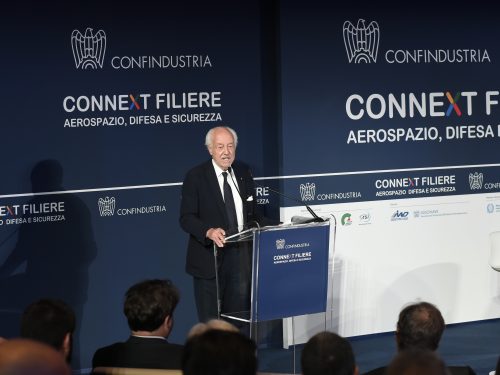
Emanuele Orsini, President of Confindustria, during the launch event for Connext Aerospace, Defence and Security Supply Chains.
“What we must avoid is these investments ending up abroad. For our business sector, the priority is to generate growth in Italy by focusing on research and development at a national level, in the knowledge that investment in the aerospace and defence sectors always generates significant dual-use benefits, with strategic applications in the civilian sphere as well,” added Orsini, who believes that: “Europe and Italy must realise that only by providing adequate resources to support their strategic supply chains will they be able to rise to the major challenge posed by the United States and China. Germany, France and Spain, in fact, are strengthening their industrial bases. We cannot afford to fall behind.”.

A sector worth over 21 billion and employing 54,000 people
Italy can, however, rely on an already well-established industrial base. The mapping carried out by the National Aerospace Technology Cluster (CTNA) and Confindustria highlight that the aerospace sector generates over 21.4 billion euros in turnover, employs 54,300 people and invests around 5% of its revenue in research and development.
This is an ecosystem characterised by a strong presence of small and medium-sized enterprises. In addition, The 80% segment of the supply chain is, in fact, made up of SMEs highly specialised centres spread across the whole country.

The round-table discussion on the role of industrial supply chains in the development of the aerospace, defence and security sectors, featuring Fausto Bianchi, President of Piccola Industria Confindustria; Maria Anghileri, President of Confindustria’s Young Entrepreneurs; and Cristina Leone, President of the National Aerospace Technology Cluster (CTNA).
The project also focuses on the defence, cybersecurity, civil aviation and shipbuilding sectors, sectors characterised by a high level of technological intensity and increasing integration between civil and military applications. In the space economy, for example, productivity exceeds the national average by 65%, whilst the Italian cybersecurity market has already surpassed 2.2 billion euros and is growing at a rate of over 12% per annum.
Urso: “Italy’s strength lies in its supply chain”
During the event, the Minister for Enterprise and Made in Italy and the Government’s Authority responsible for space and aerospace policies, Adolfo Urso who highlighted the strategic importance of the space economy for European competitiveness and the role that Italy can play thanks to its extensive and highly specialised industrial supply chain.
“Space has always been a natural part of Italy’s identity and today represents one of the greatest sources of growth potential for the Italian and European economies. It is one of the sectors in which new global economic, technological and geopolitical balances are taking shape: competition is no longer just between nations, but between continents and major industrial systems. Italy’s strength lies in its supply chain, which brings together leading national companies, highly specialised SMEs, innovative start-ups and industrial clusters spread across sixteen regions of the country,” said the minister.
“That is why we have earmarked 7.8 billion euros by 2028 to strengthen the national space ecosystem and support its growth,” added the minister, who believes that the challenge facing our country is to “transform our industrial and technological expertise into greater competitiveness, skilled employment and European leadership in the strategic sectors of the future”.

From left: Emanuele Orsini, President of Confindustria; Adolfo Urso, Minister for Enterprise and ‘Made in Italy’; and Giorgio Marsiaj, Confindustria’s Vice-President for Aerospace, at the launch event for Connext Aerospace, Defence and Security Supply Chains.
SMEs: the challenge is to drive growth throughout the supply chain
According to Confindustria, strengthening strategic supply chains also depends on the ability to support businesses in terms of scaling up, consolidation, access to finance and participation in major industrial and technological programmes. The aim is to ensure that increased investment translates into development opportunities for the entire productive ecosystem, whilst enhancing the role of small and medium-sized enterprises within national and European value chains.
“Without strong SMEs, there can be no strong supply chain,” he emphasised Giorgio Marsiaj, Confindustria’s Vice-President for Aerospace. “In an international landscape characterised by the strengthening of national industrial policies and growing competition between production systems, Confindustria aims to play an increasingly active role in fostering industrial links, investment and the scaling up of businesses. The challenge is not to create a supply chain from scratch, but to enhance and strengthen an existing industrial heritage, so that the sector’s growth translates into growth for the entire national economy. We are moving in this direction by adopting a supply-chain approach, to ensure that national leaders are able to mobilise and engage the fabric of Italian small and medium-sized enterprises, thereby enhancing the entire national industrial ecosystem.”.
Connext Filiere, the platform for strengthening the national industrial ecosystem
The project stems from the belief that major industrial challenges cannot be tackled by individual companies alone, but require robust and integrated supply chains that are capable of working together as a cohesive system. In this context, the operational tool is ConneXt Supply Chains, the proprietary digital platform developed by Confindustria, which aims precisely to bring together the skills, technologies and production capacity available in the country, creating new opportunities for collaboration between large companies and SMEs.
Aerospace, defence and security form the starting point for a journey that focuses on the strategic sectors of the Italian economy and on the ability of businesses to grow together, thereby strengthening innovation, competitiveness and industrial autonomy.