Communiqué
Print
Share on
Aleotti: Europe changes paradigm, focus on competitiveness, industrial sustainability and strategic autonomy
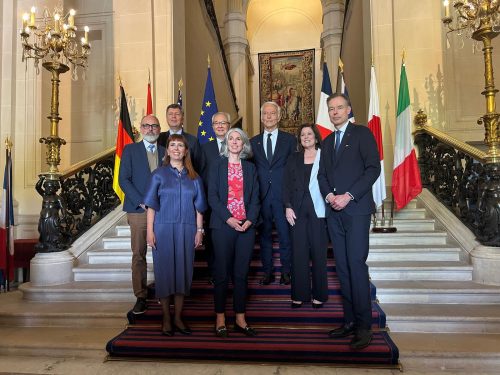
Rome, 30 April 2026 - A meeting was held today at Confindustria headquarters between the Vice President in charge of the Research Centre, Lucia Aleotti, and the European Commissioner for Animal Health and Welfare, Olivér Várhelyi, on the main European dossiers on life sciences and agribusiness.
The meeting was also attended by representatives of Assica, Confindustria Dispositivi Medici, Farmindustria and Federchimica, This confirms the cross-cutting nature of the challenges involving the health, food and advanced chemistry sectors.
Aleotti pointed out that the Italian life sciences supply chain represent 12.9% of GDP, more than 70 billion euro of exports in 2025 with growth exceeding 70% compared to 2019 and around 3 billion in R&D investment (15% of the private total), with prospects of growth to 18% by 2035. In this context, the need to ensure a uniform implementation of the European Health Data Space and the need to strengthen the European Life Sciences Strategy with a focus on technology transfer, research funding and intellectual property protection was emphasised. The Vice President also reiterated the importance of targeting the Multiannual Financial Framework 2028-2034 to support life sciences and the bio-economy. She also highlighted the need to simplify the regulatory framework for medical devices and in vitro diagnostics (MDR/IVDR), to recognise prevention policies and new health technologies as structural investments in the framework of EU economic governance, and to ensure effective European coordination on trade policies in response to recent US initiatives.
With reference to the’agribusiness, Then, Aleotti pointed out that the sector is Italy's second largest manufacturing industry, with 204 billion euro turnover (9% of GDP) and 59.2 billion in exports, strongly integrated with the national agricultural supply chain. In this context, the urgency of developing the Safe Hearts Plan on a scientific basis, avoiding simplified approaches and promoting innovative tools for consumer information was emphasised.
“A quantum leap in the European paradigm is needed: the world has changed and we cannot face today's challenges with categories from the past. Europe must strive to build and defend its strategic independence in life sciences, pharmaceuticals, medical devices and agribusiness, ensuring secure supplies for its citizens and less dependence on other geopolitical blocs,” Aleotti recalled. “Competitiveness depends on the ability to attract investment, support research and innovation, and enhance the role of industry. In sensitive sectors such as health, life sciences and agri-food, a decisive challenge is at stake, not only for the well-being of citizens, but also for the EU's economic growth and competitiveness. In pharmaceuticals, for example, the issue of industrial sustainability must be tackled realistically: excessive pressure on prices risks shifting production elsewhere. Instead, companies must be able to remain competitive, invest in innovation and maintain solid production bases in the territory. Today more than ever, it is necessary to combine industrial development and strategic autonomy while respecting clear rules and a common European vision. Defending sectors that are crucial to the lives of citizens means making them industrially sustainable, attractive, and capable of growth. Only in this way will Europe be able to strengthen its economic sovereignty and not consign its future into the hands of other continents”.