News
Share on
L'Sea Economy confirms itself as one of the country's leading industrial platforms, with a total value of more than 216 billion euro and an employment dynamic that is growing four times faster than the rest of the Italian economy. A significant boost that, however, clashes with a estimated need for about 175,000 workers in the coming years.
This is what emerges from the report Confindustria-BCG, which photographs a transversal supply chain - from shipbuilding to logistics, from tourism to fishing - capable of generating 11.3% of national GDP and employ around 1.1 million people directly, 2.5 million considering also the ancillary industries.
“The sea is not an abstract vocation of the country. It is a concrete industrial platform, which already generates value and can generate even more,” he stressed Mario Zanetti, delegate of the President of Confindustria for the Economy of the Sea at the report presentation in Genoa.
A supply chain connecting industry, services and territories
The strength of the Sea Economy lies in its systemic nature. It is not a vertical sector, but a platform that integrates industry, services, logistics and tourism, generating value along the entire production chain. In this context, Confindustria represents the only association capable of uniting and representing the entire supply chain, connecting all the main players in the system and playing a directing role for the entire sector.
The different components of the system feed off each other. Shipbuilding supports shipping and boating, which in turn enables tourism, trade and international connections. To these are added new and expanding segments, such as underwater technologies and marine renewable energies. The sea also exerts a significant multiplier effect on the economy: every euro generated in the core sectors activates further effects along the production chains and connected territories.
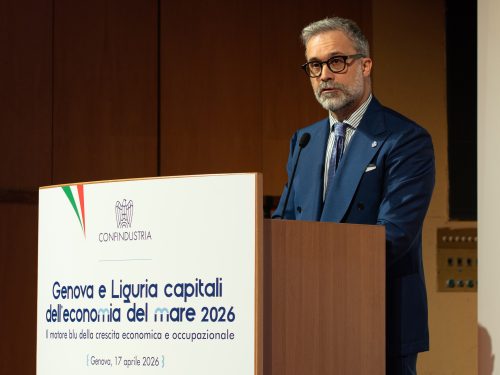
Mario Zanetti, delegate of the President of Confindustria for the Sea Economy, during his speech at the event “Genoa and Liguria capitals of the sea economy 2026” (Genoa, 17 April 2026).
Accelerated growth and centrality in global flows
In recent years the Blue Economy Italy has recorded growth above the national average, consolidating its role as an economic driver. Globally, the sea represents a critical infrastructure. 90% of freight traffic travels by sea and 99% of data transits submarine backbones.
The Mediterranean, in particular, concentrates a significant share of Europe's strategic routes and energy supplies. In this context, Italy - with over 7,900 km of coastline, 350 ports and an extensive infrastructure system - represents a natural hub between Europe and global routes, competitive positioning in the main segments of the Blue Economy.
The employment emergency: strong demand, insufficient supply
The growth of the sector is accompanied by an increasing demand for labour. The estimated need in the period 2026-2030 is about 175,000, including new employment and replacement of outgoing workers. This is a structural demand, concentrated mainly in the industrial and logistics sectors, where employment is stable and qualified. However, the system is confronted with a growing mismatch between labour supply and demand.
A dynamic that also has to contend with an unfavourable demographic context. The Italian working-age population will fall from 37.5 million in 2025 to 29.7 million in 2050, with a contraction of about ten percentage points. Over the next decade, some 6.1 million employed people aged 50 to 59 will approach retirement, compared to only 5.92 million young people aged 20 to 29.
The quantitative gap is compounded by the qualitative one.o. The training system does not produce a sufficient number of profiles with skills that are consistent with the needs of the supply chain, with criticalities more accentuated in the most strategic sectors.
“The employment problem of the sea is not cyclical. It is structural. And it requires a systemic response,” Zanetti pointed out.
In fact, companies struggle to find technical and specialised profiles, from operational figures in shipbuilding to digital and energy transition experts, with particularly high levels of difficulty in the most strategic sectors.
Innovation and transition reshape needs
The ongoing transformation in the Blue Economy is driven by energy transition, digitisation and new geopolitical balances. These changes do not reduce the demand for labour, but profoundly alter its composition, increasing the need for technical, digital and green skills and shifting value towards high-tech activities.
Three levers to support growth
To respond to these challenges and enhance the potential of the Sea Economy, the report identifies three lines of action. Simplify, to reduce bureaucratic obstacles and facilitate access to the professions. Innovate, to accompany the digital and green transition. Form, to build skills throughout the supply chain.
“More simplification, more innovation and more training mean more employment,” summarised Zanetti, indicating the three levers on which to act in a coordinated manner.
A strategic lever for the industrial future
For its part, as the report points out, Italy starts from a position of strength, with an already consolidated and internationally recognised supply chain. The challenge, therefore, is not to build a Blue Economy, but to strengthen it, increasing the value generated and bridging the human capital deficit. In this perspective, the Sea Economy represents a strategic lever for the country's employment and industrial growth, capable of combining development, innovation and sustainability.
DOWNLOAD SEA ECONOMY REPORT 2026