Share on
Sofia Felici, Chiara Puccioni, Ciro Rapacciuolo and Livio Romano
- Since last year, energy commodity prices have risen steadily, reaching critical levels as early as December 2021, and rising further following Russia's invasion of Ukraine.
- The dynamics of energy commodity prices are particularly affecting European countries, but estimates by the Confindustria Study Centre reveal that, compared to France and Germany, Italy is the country where the energy crisis is likely to cause the most damage.
- In particular, assuming pre-crisis policies remain unchanged, the incidence of energy costs on total production costs for the Italian economy is estimated to reach 8.8% in 2022, more than double the corresponding French figure (3.9%) and almost a third more than the German figure (6.8%). This would widen Italy's cost competitiveness gap with its main European partners. And this would happen across all major sectors of the economy: from the primary sector to industry and services.
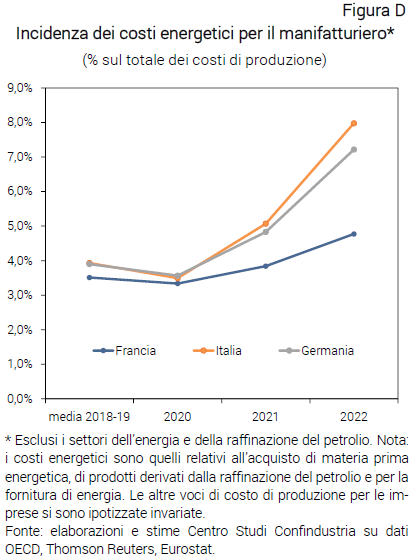
- For manufacturing, the gap would widen especially in comparison with France, but the loss of competitiveness would not be marginal even compared to Germany. By 2022, it is estimated that energy costs could reach 8.01% of production costs for Italian industry (from 4.01% in the pre-crisis period), compared to 7.2% for German industry (from 4.0%) and 4.8% for French industry (from 3.9%).
- The greater impact on Italian manufacturing companies compared to French ones is generalised across all sub-sectors, while the picture is more varied when compared to German companies: among energy-intensive industries, the damage is greater in Italy, especially in the production of wood, non-metallic minerals and chemicals, while for paper and, above all, metallurgy, which is the Italian sector most affected overall (+12 p.p. in the incidence of energy costs compared to pre-crisis levels), the impact is estimated to be even greater in Germany.
- Depending on the assumptions underlying the correlation between international energy commodity prices and the energy procurement costs of domestic companies, the impact for Italy translates into an estimated increase in the energy bill of between 5.7 and 6.8 billion on a monthly basis; for the manufacturing sector alone, the corresponding increase is estimated at around 2.3–2.6 billion.
- The main reason behind the pervasive and significant impact that the energy crisis is having on the Italian economy is linked to our country's heavy dependence on natural gas, which is much higher than in France and Germany, not only as a source of electricity production but also as a direct input into production processes.
1. An annus horribilis for energy prices
Over the last eighteen months, the international economic scenario has been characterised by an exceptional rise in raw material prices, which in many cases have reached unprecedented peaks in recent decades. The price increases have affected a wide range of commodities, not only raw materials (minerals, energy, vegetables) but also semi-finished products (including food, textile fibres and plastics, among others), and in some cases have already reached double-digit increases since the end of 2021.
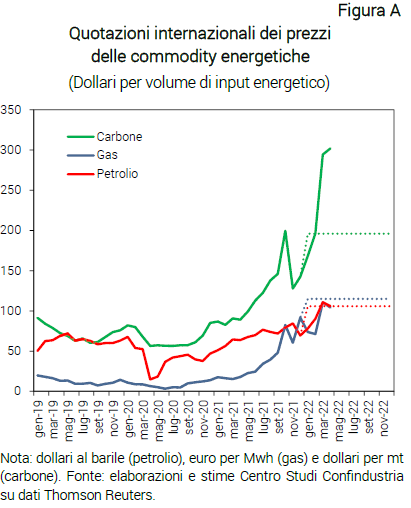
The main driver of this surge in commodity prices was natural gas, whose price in Europe had already risen by 421% in January 2022 compared to December 2019. Remaining in the energy commodities sector, oil and coal prices also rose significantly, albeit at a much slower rate than gas (+24% and +122% respectively in January 2022 compared to December 2019).
There are many reasons for these increases in energy commodity prices, relating to factors of imbalance between supply and demand that existed before the outbreak of the conflict in Ukraine, some of a cyclical nature and others more structural. However, as is now well known, Russia plays a leading role among the countries of origin of fossil fuels, accounting for almost half of EU gas imports, 44% of coal imports and almost 25% of oil imports. As a result, the upward pressure on prices that had already been underway since the middle of last year could only be amplified by the war (first expected and then real), which generated a further surge in energy commodity prices (Figure A), although so far the supply from Russia (as far as gas is concerned) has not decreased.
The uncertainties surrounding the imbalance between supply and demand for energy commodities have therefore been compounded by another critical factor: the uncertainty surrounding the duration of the energy shock, making the easing of tensions on the commodity markets more uncertain and dashing pre-war expectations of a gradual decline in prices. Indeed, over the past few weeks, fears of cuts or interruptions in supplies from Russia have further worsened the situation, casting a shadow – at least for Europe – of a possible supply deficit, especially for gas, with consequent energy rationing.
But how has the increase in energy commodity prices affected the energy costs incurred by economic activities?
2. Estimate the impact of energy price increases on production costs
Using input/output tables, it is possible to estimate the effect of increases in energy commodity prices on production costs resulting both from the purchase of raw materials (direct effect) and from the purchase of energy produced from those energy commodities and petroleum refining (indirect effects).
For direct costs, i.e. energy raw materials, the increase in international oil, gas and coal prices is weighted according to the consumption shares of each sector obtained from national energy balances sourced from Eurostat. In particular, different consumption percentages can be identified for the oil sector, for the economy as a whole, for manufacturing alone (in both cases net of oil refining) and for the energy sector.
There are two possible approaches to estimating indirect costs. The first again uses input-output tables, from which it is possible to calculate the technical coefficients for transferring the prices of imported energy raw materials to the producer prices of petroleum refining products and the producer prices of the energy sector. Applying this transfer coefficient to the increase in the price of energy raw materials, weighted by their respective consumption shares in the petroleum and energy sectors, we obtain the percentage increase in the production cost of petroleum refining and energy. Once this estimate has been obtained, we can also calculate the purchase cost of these two energy inputs by other economic sectors, i.e. the indirect cost of the increase in raw material prices incurred by them.
A second possibility for estimating indirect energy costs, but only for the item relating to the purchase of energy by the various sectors of the economic system, is to directly estimate the correlation coefficient between the historical series of natural gas prices on international markets (source: World Bank) and the series of average electricity costs for a representative national company with median consumption (source: Eurostat). In this case, the additional indirect costs incurred by the various economic operators for the purchase of energy correspond directly to the product of the increase in the international price of natural gas and the estimated correlation coefficient.
Once an estimate of the direct cost item and an average of the two estimates for the indirect cost items have been obtained, it is then possible to calculate the increase in overall energy costs for each sector and the change in the incidence that these represent on total sectoral production costs, weighting the cost increases for the respective share of total production costs for each sector, obtained from the input-output tables.
This approach allows us to take into account both the different nature of the production process in individual sectors, which involves greater or lesser energy intensity, and the dual channel through which energy commodity price increases are transmitted to the economy: as direct consumption of energy raw materials and as consumption of refined petroleum products and electricity/gas.
However, in the absence of further information – which is not currently available – it is not possible to assess the knock-on effect of energy price increases on other cost items not directly related to energy (from wages to the prices of other non-energy raw materials and semi-finished products). It is also not possible to incorporate into the estimates the effects of corrective public measures taken over the last year to curb energy cost increases for businesses – not only in Italy. The estimates are therefore to be understood as based on unchanged pre-crisis policies.
3. The effect of energy commodity price increases: a comparison between Italy, France and Germany
Estimates by the Confindustria Study Centre, based on the average changes in international energy commodity prices expected for 2022 (shown in Figure A with the dotted line), indicate that if prices do not fall back during the current year, the incidence of energy costs on total production costs (all other cost items not related to the direct consumption of energy raw materials, petroleum refining products and energy remaining unchanged) would increase for all economic activities – albeit with significant sectoral differences – affecting Italy in particular.
Comparing the estimates for our country with those obtained for France and Germany (Figure B), we can see that, even before the recent inflationary trends on international commodity markets, energy costs were higher for Italian companies than for their European competitors. The differences in the incidence of energy costs in the two-year period 2018-2019 were relatively small compared to Germany (0.6 percentage points) but already large compared to France (1.6 percentage points).
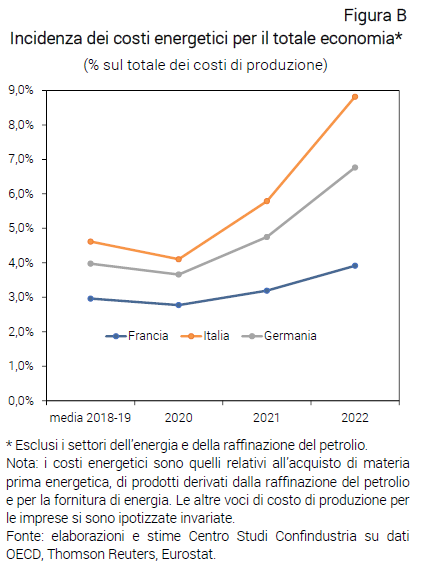
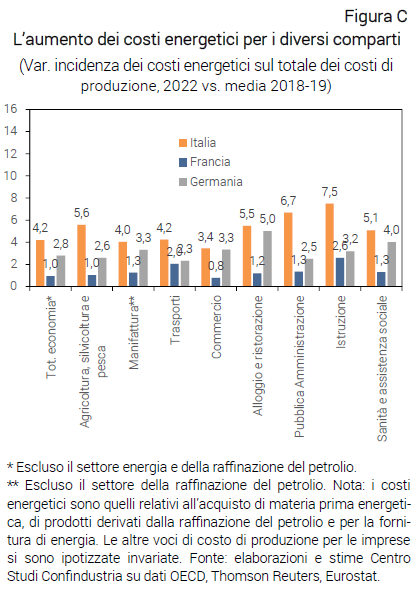
With the recent increase in energy commodity prices, the gap between Italy and Germany in terms of energy costs had already exceeded 1 percentage point in 2021, and was as much as 2.6 points higher than France. In 2022, with further price increases exacerbated by the Russia-Ukraine conflict, the gap is estimated to reach +2.1 percentage points compared to Germany and +4.9 percentage points compared to France. The higher burden of energy costs in Italy, as a proportion of total costs, is also widespread across all sectors of the economy (Figure C), affecting the primary sector as well as manufacturing and services.
Focusing on manufacturing, Italy's competitive gap is mainly in comparison with France, while the gap with Germany is growing at a much slower rate, but remains significant (Figure D). By 2022, it is estimated that energy costs could account for 8.01% of production costs for Italian industry (up from 4.01% in the pre-pandemic period), compared to 7.21% for German industry (from 4.01%) and 4.81% for French industry (from 3.91%).
The lower estimated impact of the increase in energy commodity prices on business energy costs observed in France compared to Italy is widespread across all manufacturing sectors (Figure E). However, when comparing the Italian data with the German data, the picture appears varied: among energy-intensive sectors, the rise in energy commodity prices is estimated to have a greater impact on Italian manufacturing, especially in the wood sector (with a change in the incidence of costs of +6.3 percentage points compared to pre-pandemic levels, against +2.3 p.p. in Germany), rubber and plastics (+5.6 p.p. vs. +3.2 p.p.), non-metallic minerals (+8.8 p.p. vs. +7.3 p.p.) and chemicals (+4.5 p.p. vs. +3.6 p.p.), while for metallurgy, despite being the Italian sector most affected by the energy crisis, the increase would be even greater in Germany (+12.4 p.p. vs. +14.4 p.p.). German manufacturing is estimated to be more affected than Italian manufacturing in the paper and printing macro-sector (+5.0 p.p. vs. +5.7 p.p.).
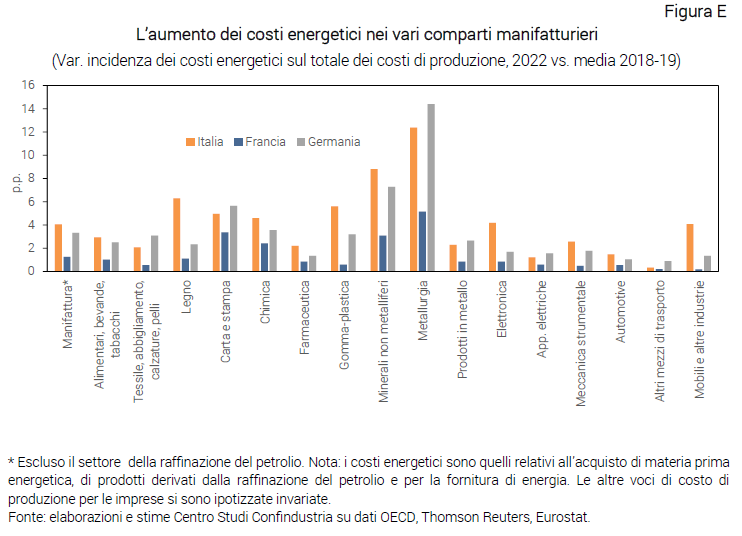
Overall, therefore, despite the fact that raw material price increases have a significant impact on energy costs in all sectors and in all countries, Italy appears to be the most affected.
In monetary terms, according to estimates by the Research Centre, this impact would translate into an increase in Italy's energy bill of between €5.7 and €6.8 billion per month, depending on the assumptions underlying the estimates, or an additional cost of between €68 and €81 billion per year. Looking at the manufacturing sector alone, the increase in energy costs can be quantified at between €2.3 and €2.6 billion per month, or between €27.3 and €31.8 billion per year. For Germany, the increase in energy costs is estimated at between €7.7 and €8.0 billion per month (€91.9–€95.7 billion per year) for the economy as a whole and at around €3.7–€3.8 billion per month (€45.9 -47.2 billion per year) for manufacturing alone, while for France, estimates range from 1.7 to 1.8 billion per month (20.2-21.8 billion per year) for the economy as a whole and approximately 0.6 billion per month (7.5 billion per year) for manufacturing alone.
4. The importance of gas in Italy's energy mix
This heterogeneity among European countries can be explained primarily by the different mix of energy sources used, both those demanded directly by businesses to carry out their economic activities and those purchased indirectly through energy supply.
In particular, based on Eurostat data, natural gas is the main source of consumption in Italy both for the energy distribution sector (approximately 49% in 2019) – which then supplies it in the form of gas and electricity to other sectors of the economy – and directly for manufacturing (76%). On the contrary, natural gas is a marginal source of consumption for the energy sector in both Germany (15%, compared to 44% for coal) and France (4%, compared to 83% for nuclear), while for manufacturing in the two countries, the significant weight (68% and 67%) is much lower than in Italy (Table A).
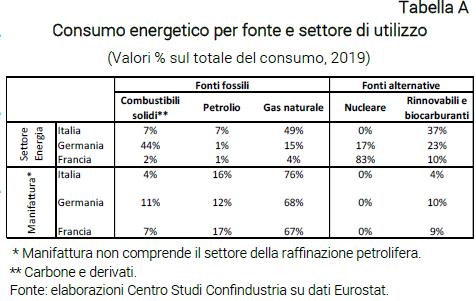
This implies that “off-scale” gas price variations, such as those we are seeing in recent months and which continue to drive up the price of electricity, have a proportionally greater impact on Italian industrial supply chains than on German and French ones. Furthermore, in Italy, it should be noted that in recent years, domestic companies have been using fewer long-term contracts for natural gas supplies in favour of more spot market purchases, which has increased operators' exposure to fluctuations in the spot prices of this energy commodity.

Related











Join the largest business community in Italy.
Highlighted topics
Our Platform