Share on
The project
Critical raw materials (CRM) are a central node of European economic security. In an international context marked by increasing geopolitical fragmentation, rising protectionist measures and tensions on global value chains, supply chain resilience has become a strategic priority.
The project CASCADE, carried out by the inter-university network Re4It (University of Bologna, University of Bergamo, University of L'Aquila and Politecnico di Milano) in collaboration with the Confindustria Centro Studi and financed by MUR in the framework of the PRIN-PNRR, analyses the vulnerabilities of Italian industrial supply chains with respect to four critical raw materials (aluminium, copper, titanium and rare earths) that are crucial for the ecological, digital and technology-intensive sectors' transition, providing a five-year prospective assessment based on a Delphi study involving 45 experts on the subject.
The international scenario and critical dependencies
- After pandemics and geopolitical conflicts, the tension between trade openness and strategic autonomy has become central again: dependencies can turn into vulnerabilities. The prevailing response is not decoupling, but diversification and strengthening resilience in strategic sectors.
- In recent years, uncertainty, protectionist measures and conflicts have increased, creating greater risks for supply chains. Despite this, global manufacturing integration remains high: about a quarter of world manufacturing and over 37% of Italian manufacturing are linked to global value chains, while China has reduced its supply dependency by strengthening domestic production.
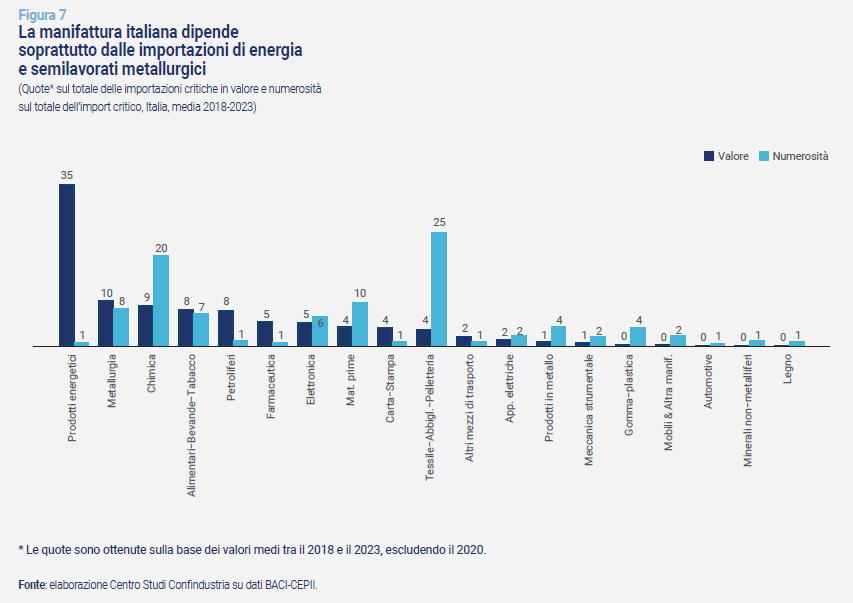
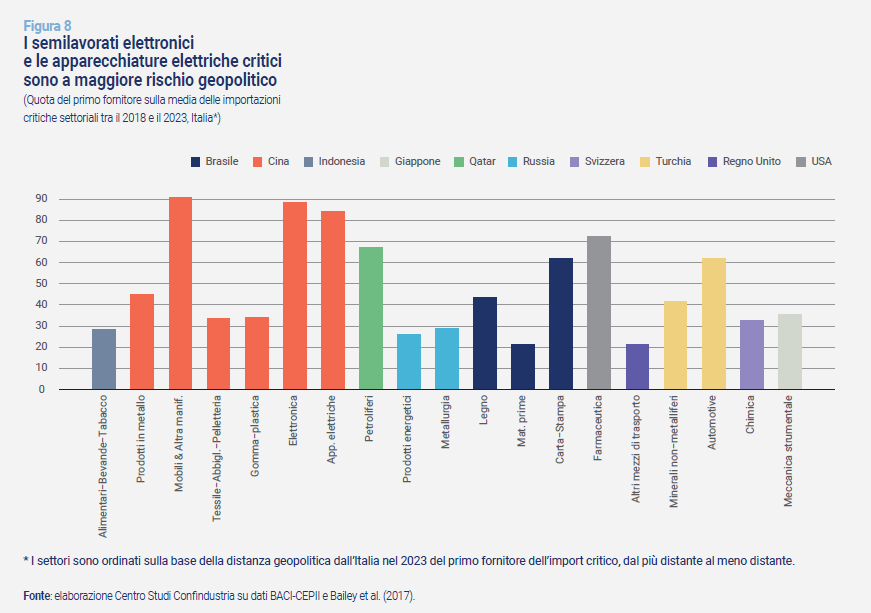
- The Italian manufacturing industry is significantly dependent on non-EU supplies for 364 products (raw materials, semi-finished products and capital goods), worth approximately EUR 26 billion. The most exposed sectors are semi-finished metal products and energy; China is the main supplier of critical products.
The CASCADE project: dependency mapping and prospective evaluation using the Delphi method
- The research analyses four critical raw materials (aluminium, copper, titanium and rare earths) in three strategic supply chains: aerospace; defence and security; pharmaceutical and cosmetics packaging; industrial automation, mobility and renewables. Through a multi-level supply chain analysis - from focus groups to a Delphi study with 45 experts - CASCADE assesses the expected criticality of supplies, their impacts, mitigation strategies and the main obstacles to their implementation.
- The results indicate a tightening of supply conditions due to: rising and volatile prices (a critical issue across all materials), availability and difficulties in finding materials, and tensions concentrated mainly on rare earths and titanium. Vulnerabilities arise from: growing global demand, geographical concentration of supply, geopolitical tensions and difficulties in substituting materials. These criticalities tend to propagate along the supply chain, especially in the technologically advanced sectors: aerospace and defence (titanium, aluminium), electrification and electronics (copper) and magnets and advanced technologies (rare earths). Sustainability improves the environmental profile but without reducing supply risks. Only in the case of rare earths does recycling also enhance resilience.
Final reflections
The risk on critical raw materials is structural and requires a multilevel approach integrating industrial policy, trade policy and international cooperation. The most effective response is the policy coordination at European level. At the national level, CASCADE proposes a “vertical” approach: mapping by supply chain of uncovered or undersized stages, evaluation of the creation or integration of operators, incentives for reshoring and co-development, greater dissemination of financial hedging instruments among SMEs to manage price volatility.

Related





Join the largest business community in Italy.
Highlighted topics
Our Platform