Share on
Giovanna Labartino, Francesca Mazzolari and Giovanni Morleo*
(reference year 2021)
- The annual Confindustria survey on employment conditions in member companies, carried out between February and April 2022, provides information for 2021 on the structure of employment and corporate labour management policies in member companies. Summary and comparative tables on the main variables surveyed are available at this link.
- This year's survey also returns to data on working hours and absenteeism, which were not collected in 2020 as they were largely influenced by the use of forms of (total or partial) work suspension. Also confirmed this year is the in-depth study on the use of smart working by companies, also due to the structural spread of this mode of work organisation after the health crisis.
- The results indicate that, prior to the pandemic, smart working was already present in more than one in ten of the companies that participated in the survey (11.2%). In particular, this way of working was more widespread in services, partly due to the very nature of the activity: 14.4% of companies used it, compared to 9.4% in industry in the strict sense.
- During the acute phases of the health crisis, smart working was adopted by companies to ensure the necessary interpersonal distancing, which is crucial to avoid the spread of contagions, and the adoption of this working mode reached very high peaks. In the first quarter of 2022, more than a third of companies were still using it (37.6%), as the sum of the 27.7% that used the “simplified” scheme (introduced in 2020) and the 9.9% that had already adopted it “structurally” (according to the provisions of Law 81/2017).
- Looking ahead, in the post-pandemic, it is estimated that the prevalence will remain twice as high as in the pre-pandemic (at 20.3%), adding the companies that in the first half of 2022 were planning to introduce it within 2 years (10.4%) to those that had already introduced it (9.9%). Again, it is the service sector that presents a higher figure than the industrial sector (26.3% and 16.8%, respectively).
- The survey also gathered information on other company policies adopted by companies in a particularly complicated year: the use of wage subsidies, the application of company collective agreements and the matters regulated by these agreements.
- The results confirm a gradual re-absorption of the use of social shock absorbers in 2021. Over the course of the year, 31.9% of the companies surveyed made use of wage subsidies (ordinary CIG, in deroga or ordinary allowance). The percentages are 31.5% and 32.8% in industry in the strict sense and services, respectively.
- With regard to company bargaining, it is noted that, at the beginning of 2022, company bargaining involved almost a quarter of the member companies (23.3%). The spread is greater in industry in the strict sense (where the company contract is present in 30.8% of companies) than in services (16.9%) and in larger companies with more than 100 employees (66.8%) than in smaller ones with less than 15 (10.2%).
- The prevalence of company bargaining shows higher percentages when calculated on the basis of employees: 60% of the employees in the overall sample are employed by companies that apply it - average between 69.6% recorded in industry in the narrow sense and 47.2% recorded in services.
- The subjects regulated by the company contract, when present, are mainly collective performance bonuses (62.2%), working time (in 53.9% of cases), work-life balance (35.1%), corporate welfare (31.5%) and safety protocols (30.7%).
1 . Employment in Confindustria System companies in 2021
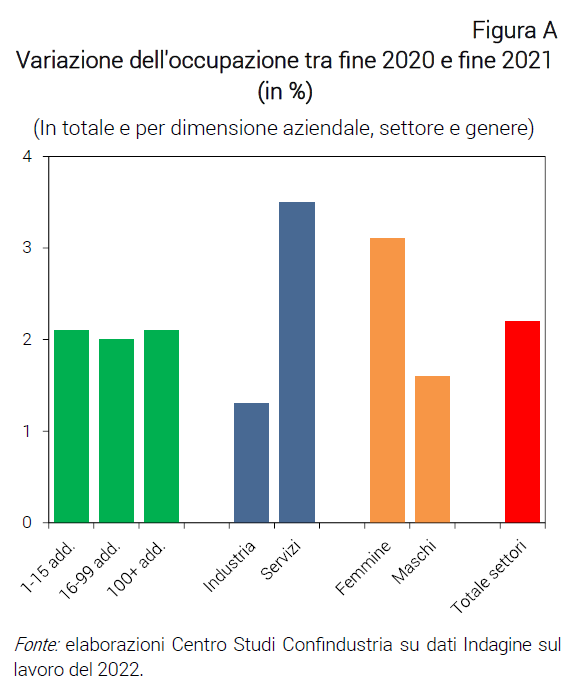
Employment increased, driven by fixed-term contracts In 2021, total dependent employment in Confindustria member companies increased by 2.2%, summarising an increase of 3.5% in service companies and 1.3% in industry. The increase involved enterprises of all size classes, from those with fewer than 15 employees (+2.1%), to those with 16-99 employees (+2.0%), to those with more than 100 employees (+2.2%).
In the associated enterprises, employment of the male component increased by 1.6%% in 2021, while female employment grew more significantly (+3.1%; Figure A).
With respect to contract type, there was a boom in fixed-term employment over the past year (+41 %), which accounted for 5.8% of total employees in member companies at the end of 2021. Permanent employment held up (+0.7% over the year), which is by far the most common in member companies (91.9% of employees are employed under this contract). Apprentices were substantially stable (-0.21 FTE6T), but the average figure hides a differentiated trend between sectors, with an increase in industrial companies (+8.81 FTE6T) and a contraction in service companies (-14.61 FTE6T).
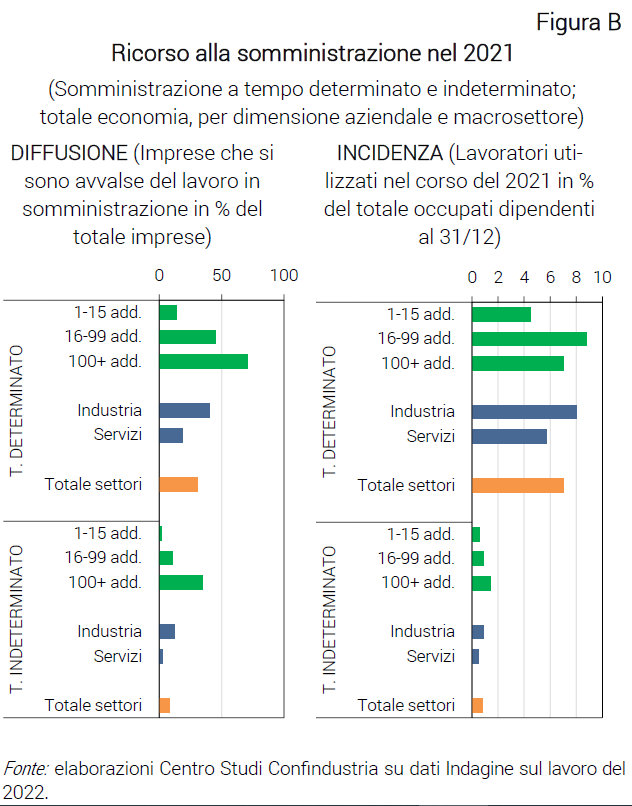
Widespread use of administration contracts Almost a third of the member enterprises (30.5%) employed at least one temporary agency worker in 2021, with a higher prevalence in industry (40.1%) and large enterprises (70.4%). To give an idea of the intensity of use, consider that the number of agency workers used by the company overall in the year averaged 7% of the total workforce reported as at 31 December 2021.
On average, permanent employment was used by 8% of companies, again more so in industry (12.1%) and large companies (34.9%), for a share of workers administered during the year amounting to 0.8% of the company workforce (Figure B).
Use of social shock absorbers still relevant During 2021, 31.9% of member enterprises made use of social shock absorbers with “Covid-19” (CIG ordinary and in deroga and the ordinary wage supplement allowance), with similar results between industry (31.2%) and services (32.8%). Utilisation affected larger enterprises (100+ employees, at 39.1%) more than smaller ones (30.2% for enterprises with less than 15 employees, 32.7% for enterprises in the medium size class).
Higher labour turnover in services As in previous editions, this year's survey measures inbound and outbound turnover. First of all, the companies with zero turnover (i.e. companies that, based on the data provided in the questionnaire, neither entered nor exited personnel) accounted for 23.3% of the sample.
The overall turnover rate (the sum of workers hired and terminated during the year over total employment at the end of 2020) was 35.5% in the average of the sample analysed. Turnover is significantly higher in service enterprises (50.5%) than in industry (26%) and affects small enterprises the most (58.9% in enterprises with fewer than 15 employees, while it is 36.9% and 32.2% in medium-sized and large enterprises, respectively). Inbound turnover is 18.8%, while outbound turnover is 16.7%.
Difficulties in finding the necessary skills for a quarter of companies Responding companies were asked whether in 2021, apart from the shock due to the pandemic, their planned recruitment had been limited by any specific factor. Compared to the 31.3% of companies that had not planned to recruit and another 41.9% that had not experienced any limitations, as many as a quarter reported having experienced difficulties in finding the necessary skills (24.9%), a proportion that rises to a third among companies with at least 100 employees (33.1%). Both the proportion of respondents reporting limitations linked to the freeze on redundancies (in force, in principle, until 30 June 2021 for industrial and construction companies and until 31 December 2021 for companies in other sectors), and the proportion citing the use of smart working as a deterrent (e.g. due to related difficulties in training/introducing new hires) are marginal (around 21.91 FTE6T).
2. Absences from work in 2021
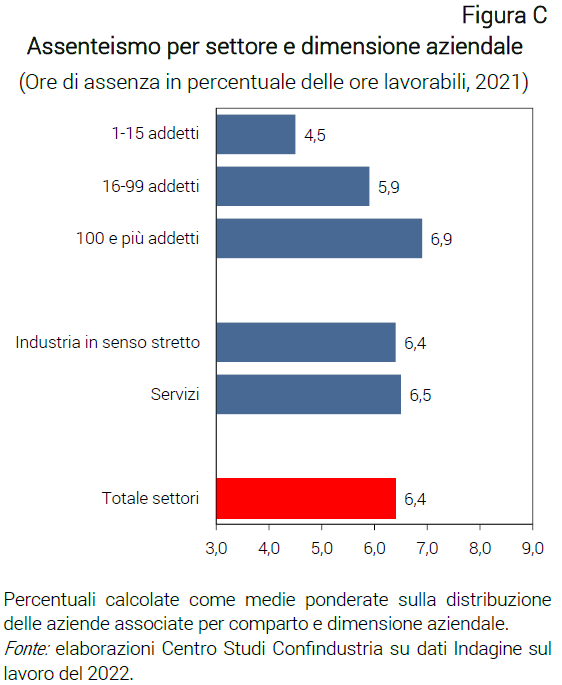
Higher absenteeism rates in larger companies In 2021, the per capita working hours, net of Wage Guarantee Fund hours, averaged 1,6721. Of these, 107 were not worked due to absence from work (paid and unpaid). The absenteeism rate (calculated as the ratio of hours of absence to hours worked) thus stood at 6.4%.
The incidence of absences, as calculated on the basis of data from the Confindustria labour survey, was similar in industry in the narrow sense (6.4%) and in services (6.5%).
The absenteeism rate continued to increase with increasing company size: 6.9% in those with 100 and more employees, 4.5% in those up to 15 (Figure C).
Different causes of absence by gender Non-occupational illness was confirmed as the most frequent cause of absence (3.4% of working hours), followed by other paid leave (1.3%), which includes trade union leave and leave for medical examinations or parental accompaniment, and paid leave (1.0%). The incidence of absences was 5.8% among men and 7.7% among women. Parental leave explains almost all of the difference, accounting for 2.4% of the working hours for women and 0.5% for men, due to the burdens of family care, since those borne by the female gender are far greater. It should be noted, however, that the rate of absences due to parental leave is decreasing compared to what was recorded for 2019, particularly for female employees (for the latter, from 3.5% to 2.6%), presumably also as a result of the use of smart working as a work-life balance tool.
3. Company policies and smart working
One in four member companies with company bargaining Among the companies that participated in the last survey, about a quarter (23.3%) stated that they applied a company contract, i.e. one signed with RSU/RSA or territorial representations. Agreements are much more widespread in large companies (66.8% among those with at least 100 employees) than in small ones (10.2% if there are no more than 15 employees). Consequently, the proportion of employees covered by a company agreement in the overall sample is higher than the proportion of companies (60.0%).
Among the subjects regulated in company contracts, first and foremost, collective performance bonuses: almost two thirds of the contracts provide for this (62.21 FTE6T), and the share rises to 85.71 FTE6T among companies with at least 100 employees (92.01 FTE6T if operating in industry net of construction).
The regulation of working time (53.9%), work-life balance (35.1%) and smart working (25.5%) are also widespread in company bargaining.
Concerning welfare payments (additional to law, CCNL and company regulations), almost a third of company contracts provide for it (31.5%) and about a quarter provide for the option of converting performance bonuses into welfare (24.4%).
Focus on smart working Beyond the peaks of diffusion reached during the acute phases of the health emergency, in order to anticipate the prospects for the diffusion of smart working in the near future, this year's survey noted the degree of use of this form of work by member companies, distinguishing between those that at the time of the survey (February-April 2022) were making use of the simplified regime (so-called “emergency”, introduced in 2020) and those that had already adopted it “structurally” (according to the provisions of Law 81/2017), or intended to do so by 2024.
Companies that had adopted smart working on a structural basis at the beginning of 2022, or were planning to adopt it within two years, were also asked a series of additional questions regarding how agile work was introduced in the company, the conditions of access envisaged for workers, as well as the opportunities and limitations perceived by the company in relation to this type of work performance, and the investments and organisational changes made or planned, specifically in relation to the agile work option.
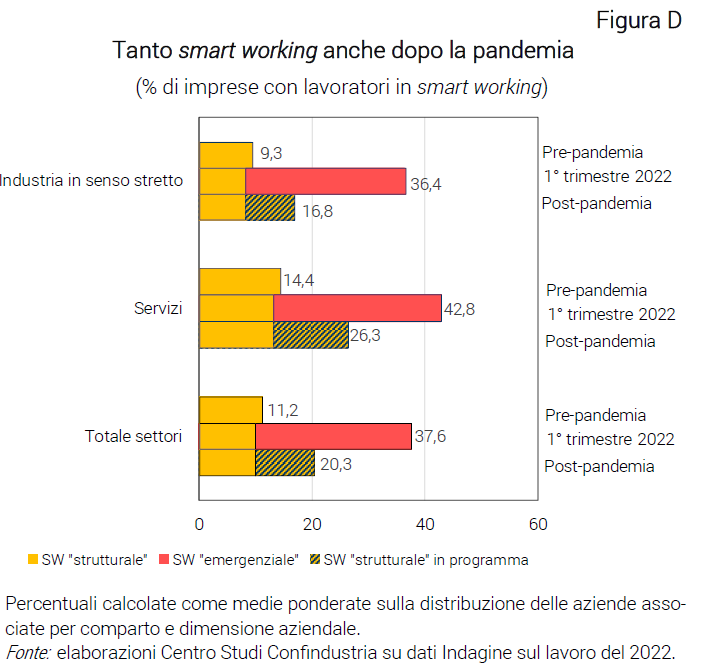
Smart working also widespread in the post-pandemic The results indicate that, prior to the pandemic, smart working was already present in more than one in ten companies (11.2%). In particular, this way of working was more widespread in services, partly due to the very nature of the activity: 14.4% of companies used it, compared to 9.4% in industry in the strict sense.
During the acute phases of the health crisis, smart working was adopted by companies to ensure the necessary interpersonal distancing, which is crucial to avoid the spread of contagions, and the adoption of this working mode reached very high peaks. In the first quarter of 2022, more than a third of companies still used it (37.6%), as the sum of the 27.7% that used the simplified scheme and the 9.9% that had already adopted it “structurally”.
Looking forward, in the post-pandemic, it is estimated that the uptake will remain twice as high as in the pre-pandemic (at 20.3%), adding the companies that in the first half of 2022 were planning to introduce it within 2 years (10.4%) to those that had already introduced it (9.9%). Again, it is the service sector that presents a higher figure than the industrial sector (26.3% and 16.8%, respectively; Figure D).
The modalities of introduction and conditions for access to “structural” smart working” More than two out of five enterprises use only individual agreements (42.5%): in industry in the narrow sense 39.6%; in services 44.3%. The remainder use modes of regulation in addition to the individual agreement alone, mainly company regulations.
Access to smart working is mainly attributable to the compatibility of the task (86.6%), but also to the appropriate conditions for connection (64.6%) and belonging to specific company areas (55.3%).
How many workers involved and for how many days per week? According to company responses, two in five workers are/will be involved in «structural» smart working (40.1%). 8.8% of workers in companies that have adopted or will adopt smart working on a structural basis work/will work ’remotely“ for a maximum of one day a week (9.7% in industry in the strict sense; 7.8% in services). A balanced mix of ”in-presence“ and ”remote“ work prevails: a maximum of 2 or 3 days working remotely (26.3%).
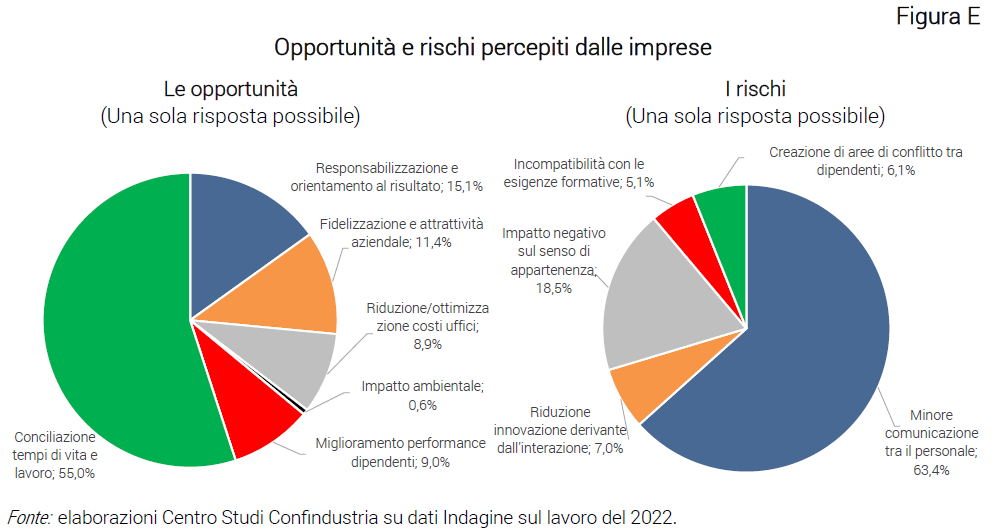
Opportunities and risks perceived by companies When questioned about the main motivation that led them to structurally introduce smart working (only one answer possible), more than half of the companies indicate an advantage for employees, i.e. the possibility of reconciling life and work times (54.7%). In second and third place are reported the positive impact on employee empowerment and results orientation that this organisational mode reinforces (15.0%) and the value of smart working as a tool for company loyalty and attraction (11.4%). Economic evaluations - cost reduction made possible by space efficiency and increased worker productivity - are respectively reported as the main motivation by less than one in 10 companies.
When asked about the main risk associated with the possibility of working remotely, the majority of companies are concerned about reduced opportunities for interaction, with a negative impact on communication (63.0%) and the sense of belonging (18.9%). More circumscribed are the risk of a negative impact on the possibility of generating innovation (7.0%), the incompatibility of smart working with the training needs of young and newly-employed workers (5.2%) and the fear of conflicts between eligible and non-eligible workers (5.9%; Figure E).
With smart working, what investments and organisational changes? The survey also investigated whether companies that have introduced or are about to introduce smart working structurally have invested in technology and/or staff training, and whether they considered organisational changes necessary.
65.3% of the companies provided laptops for their employees, 46.9% provided IT security tools, 36.8% equipped their employees with telephones.
Interestingly, more than one in four companies have invested (or plan to invest) in space/office reorganisation.
More than one in three companies provide technical training for their workers (37.1%), 32.1% provide training on soft skills, 25.6% provide safety training (in addition to compulsory training). But 32.8% do not provide any training for their staff.
36.8% of companies have implemented systems for evaluating the achievement of objectives, and 5.2% plan to introduce specific parameters for the productivity bonus. But the percentage of companies that do not plan any organisational changes is very high (62.6%).

Related












Join the largest business community in Italy.
Highlighted topics
Our Platform