Communiqué
Print
Share on
MARITIME ECONOMY: CONFINDUSTRIA MEETS DEPUTY MINISTERS GAVA AND RIXI
Lorusso: 'Growth sector for the whole country. Enhance it through constant comparison and rigorous coordination action'.
Grassi: 'Italy a natural bridge with North Africa and the Middle East. ZES and Zls tools to seize this competitive advantage'.
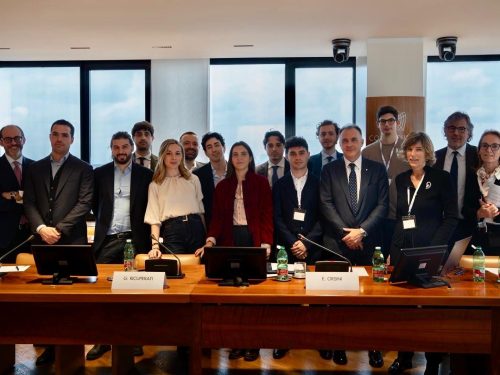
Rome, 14 March 2023 - Today the Confindustria (Confederation of Italian Industry) Table for the Sea Economy, chaired by the Vice-President for the Sea Economy, Pasquale Lorusso, met at Confindustria in the presence of Vito Grassi, Vice-President of Confindustria and President of the Council for Regional Representations and Territorial Cohesion Policies of Confindustria, and composed of representatives of all the main categories involved in this sector. The meeting was attended by the Deputy Minister for the Environment and Energy Security, Hon. Vannia Gava, and the Deputy Minister for Infrastructure and Transport, Hon. Edoardo Rixi, for a discussion between the industrial system and the institutions, with a view to cooperation between the public and private systems. Vice-President Lorusso shared with the Deputy Ministers the 'Progetto Mare', the document illustrating Confindustria's strategic guidelines on the Economy of the Sea and the priorities identified in four specific areas: Reforms and Governance; Infrastructure and Intermodality; Industrial Policies; Territorial Cohesion.
"The Sea Economy is an extremely complex and articulated cluster, centred on the valorisation of natural resources such as the sea and the coasts. The numerous and widespread port infrastructures of different size, economic relevance, function, and logistical and productive integration, as well as the coasts, with their environmental, naturalistic, landscape, tourist, and recreational value, constitute a development driver for the entire country," said Confindustria's Vice President for the Sea Economy, Pasquale Lorusso. "In fact, it is a sector that generates a positive impact not only on the economic activities within its perimeter, but extends across the entire supply chain. It is an example of a 'dedicated' industrial policy on which to focus for Italy's recovery and growth. The Economy of the Sea has enormous potential that needs to be unleashed and developed, also thanks to the support of the huge resources put in place by Europe to tackle the dual environmental and digital transition and increase cohesion,' Lorusso noted. "It is therefore necessary to have a broad vision of the Economy of the Sea, based on the industrial, tertiary, tourism and environmental opportunities offered by the use and exploitation of the 'sea resource', which is certainly the first lever capable of projecting Italy to the centre of the Mediterranean as a logistics platform. In this sense," concluded Vice President Lorusso, "we need to think in a medium-long term perspective, of which a direct and simplified interlocution with the various institutions involved, through a periodic comparison and a constant and rigorous action of coordination between the instances of the different souls of the sector, constitutes the backbone.
For Vice President Vito Grassi, 'Italy's geographical position is a natural bridge to North Africa and the Middle East and, consequently, it is at the centre of trade between the 'Far East' and Europe. Nature has given us a competitive advantage, which it is now up to us to exploit in order to make our country a logistics and energy hub for the whole of Europe. In this sense, it is essential to focus on the development of Special Economic Zones and Simplified Logistics Zones. These are, in fact, fundamental tools for developing the connections between manufacturing, logistics, and the economy of the sea from a territorial, national, and European perspective.