News
Share on
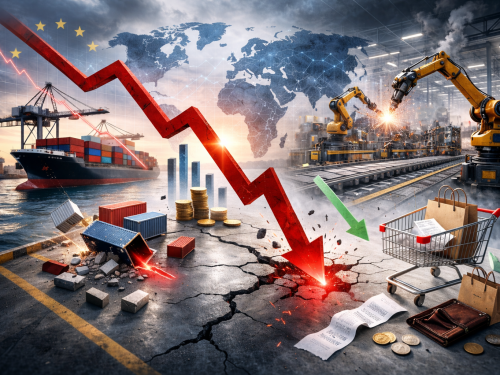
La Flash Conjunction December Confindustria Centro Studi paints a complex economic picture. In the fourth quarter, the dollar was weak against the euro, partly as a result of repeated interest rate cuts by the Federal Reserve, continues to hold back Italian exports, along with US tariffs. Household confidence and consumption expectations are weakening again, while industry is struggling to recover. On the other hand, investments, driven largely by PNRR, the stability of services, driven by foreign tourism, and the fall in oil prices.
Moderate rates, but credit still expensive for businesses
In December, for a few days, the yield on BTP fell below that of French bonds; on average for the month, rates remained broadly in line: 3.49% in Italy and 3.48% in France, while Spain recorded lower values (3.23%). With rates ECB At 2.00%, the cost of credit for Italian businesses shows no further reduction and remains high (3.52% in October).
In United States The FED has reduced official rates for the third consecutive session, bringing them to 3.75% in December and announcing further reductions without a defined timetable. This contributes to keeping the dollar undervalued against the euro, close to its highs for the year.
Energy: oil prices fall, electricity still expensive
The slow decline in oil prices continues, falling to $63 per barrel, just below the 2019 average. Gas prices have also fallen (€27/MWh), but remain at levels still double those seen before 2022. Consumer inflation in Italy thus remains moderate (+1.11% in November), while the The cost of electricity for businesses remains significantly higher than in the main European partner countries..
Investments still strong, consumption held back by confidence
Following the strong performance in the third quarter, indicators for investment in plant and machinery remain favourable even at the end of 2025: industrial electricity consumption is increasing and confidence among manufacturers of capital goods remains high, as does confidence in the construction sector, despite a slight recent slowdown.
On the consumption front, retail sales grew moderately in October, while car registrations showed a modest increase in November. Employment returned to growth between September and October, but household confidence fell sharply in November, recovering only partially in December.
Services accelerating, industry still weak
Services continue to expand: indicators CSC-TeamSystem indicate a strengthening of activity in October, and the services PMI confirms a healthy pace of growth in the fourth quarter. Industry, on the other hand, remains in difficulty: industrial production fell again in October and, despite some signs of recovery in metallurgy and the furniture sector, critical issues persist in fashion and automotive.
Exports down
In October, Italian trade in goods was weak: imports were almost stagnant (+0.31% at current prices), while exports fall by 3.01%, after the rebound in September, mainly due to the collapse of capital goods. The upward trend in sales is concentrated in certain sectors, particularly pharmaceuticals, and in specific destinations such as Switzerland, OPEC countries, France, Spain and the United States. The outlook remains negative, with a further decline in foreign manufacturing orders in December.
Europe, the United States and China: mixed signals
In the Eurozone services show a more favourable trend compared to industry, while in the United States there are signs of a slowdown, especially in manufacturing and the labour market. In China, industry is slowing down but exports are growing again, supported by sales to markets other than the US, while domestic demand remains weak.
Focus on tourism: a significant contribution to growth
The Tourism continues to be a supporting factor for the Italian economy.. Foreign tourist spending is on the rise and the tourism balance remains largely positive, contributing significantly to foreign accounts and GDP. In this context, the sector remains a key element of resilience, especially during a period of weakness in the industry.
READ THE DECEMBER ECONOMIC FLASH REPORT